
Wine Bottling Equipment: Building a Supplier Brief
How a winery can turn wine style, oxygen targets, bottle, closure, capsule and label choices into a brief that equipment suppliers or mobile bottlers can quote.
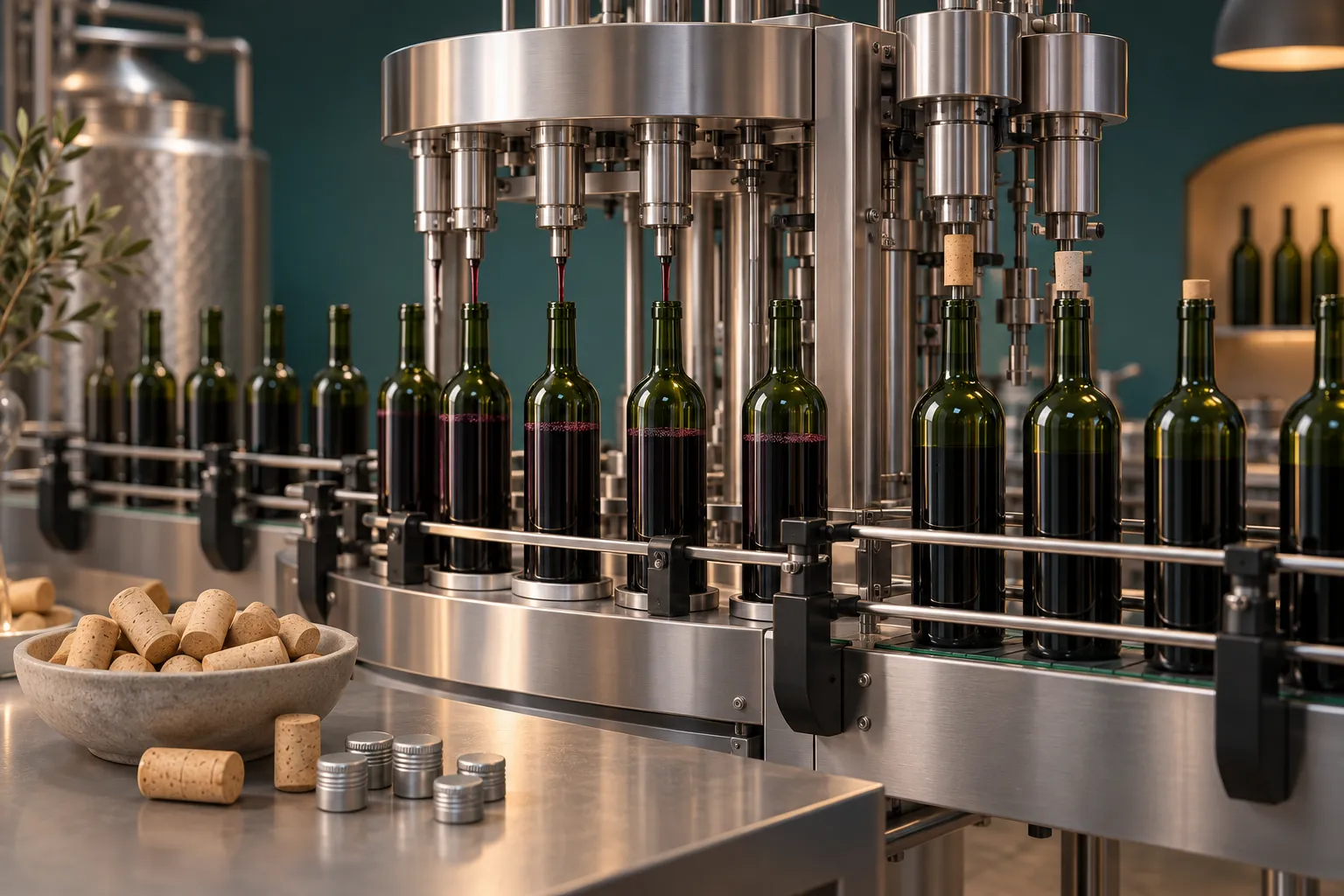
A supplier can only quote a wine bottling line or a mobile bottling day against facts: what wine is going into the bottle, how oxygen-sensitive it is, whether it is still or carries CO2, which bottle and closure you chose, and how many bottles you must pack in what time. A brief that states these up front lets suppliers propose comparable configurations instead of guessing.
This guide turns winery decisions into brief sections: wine and pressure, oxygen management, bottle and closure, capsule and label, cleaning and sanitation, and the choice between a mobile bottler and an owned line. It is editorial analysis of extension, standards-body and trade sources; it does not recommend equipment or suppliers. Once the brief is drafted, Bottling Equipment RFQ Checklist: Comparing Supplier Proposals shows how to compare the responses.
Start with the wine, not the machine
The first brief section describes the product, because pressure and oxygen sensitivity decide which fillers and closures are candidates at all.
- Still or carbonated. CETIE, a European bottling-guide body, treats wine as still when CO2 content is below 1.2 g/L (as defined in EN 16293). Its separate guide for pressurized wines (above 1.2 g/L) on BVS finishes warns of special precautions above roughly 3 g/L CO2 or 6 bars, and a different guide covers in-bottle secondary fermentation on 29 mm and 26 mm crown closures. Sparkling and still lines are not interchangeable.
- Style and oxygen sensitivity. Ohio State University extension material, citing Fugelsang (2009), recommends total dissolved oxygen in bottled red wines below 1.25 mg/L and below 0.6 mg/L for white, blush and rose wines. State your own target and how you measure it.
- Microbial stability. A filter maker’s technical page (Pall) notes that residual sugar plus yeast left after fermentation can cause refermentation and, in severe cases, broken bottles, and describes pre-filtration and final filtration as the way to protect bottled stability. Say what filtration you will deliver to the filler (for example, the sterile filtration step) and whether the supplier is expected to provide it.
- Volume and schedule. Annual cases, lot sizes, number of SKUs, bottling windows and any shift-length limits.
Oxygen management: what to put in the brief
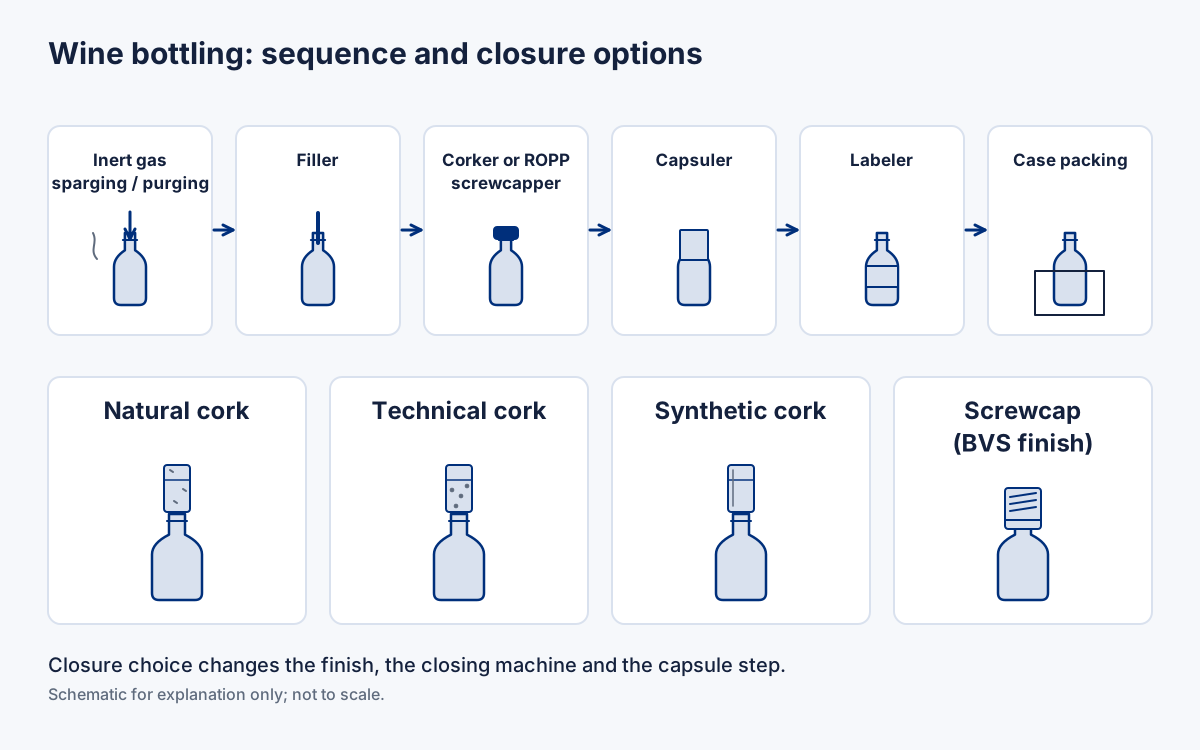
Oxygen can enter at transfer, filtration, filling, bottle headspace and closing. The OSU extension document lists key pickup sources as racking, excess headspace, pumping, filtration and bottling, and says that depending on filler type, filling can raise dissolved oxygen by 0.5 to 2.0 mg/L (citing Peynaud, 1984). It describes several practices: purging tanks and lines with inert gas, covering the filler bowl, vacuum before filling with nitrogen flushing, injecting inert gas or liquid nitrogen into the headspace, and, for corking machines, vacuum if set up properly. It also advises keeping the time and distance between filler and closer short, and notes that after a stoppage the gas can escape, so affected bottles should be re-dosed or removed.
The brief can put these questions to suppliers:
| Brief item | What to state or ask |
|---|---|
| Oxygen target | Your dissolved oxygen and total package oxygen targets, and how and where they will be measured |
| Filler type | Gravity, vacuum-assisted or isobaric, with the supplier’s reason; see Glass Bottle Filling Machines: How to Compare Filling Principles |
| Bottle pre-treatment | Vacuum, inert gas flush, or both; number of cycles |
| Headspace control | Gas or liquid nitrogen dosing, vacuum at the closer |
| Gas supply | Gas type (nitrogen, CO2, argon), who supplies it, and filtering of gases |
| Stoppage handling | Procedure for re-dosing or rejecting bottles after a stop |
A supplier’s oxygen figure is a claim until measured. Ask for the conditions under which it was obtained.
Bottle and closure: set the interface first
The bottle and closure define what the filler, closer and labeler must handle. Send the supplier the bottle drawing and, ideally, sample bottles. Two mobile bottlers interviewed by Midwest Wine Press said that bottle size variation causes problems (a bottle too large will not fit the equipment, one too small gives play at the cork or cap); one requires a detailed bottle drawing and both obtain sample bottles in advance. Weight also matters; lighter bottles may need handling changes, as covered in Lightweight Wine Bottles: What Buyers Should Verify.
Cork or screwcap
CETIE’s bottling guides state which finish goes with which closure: cork stoppers on a cork-mouth finish per EN 12726 (and the user must run sealing tests if applying on another finish), and aluminum screw caps for still wines on BVS-type finishes per EN 16293, applied with a thread and crimped seal. Cork and screwcap lines need different closers, and some bottlers offer only one. A Grapevine Magazine article quotes a mobile bottler saying many wineries keep cork for reds but use screwcaps for whites, so a bottler who cannot do both may lose clients.
On oxygen, the OSU document, citing Lopes et al. (2007), reports oxygen permeation lowest for screw caps and technical corks, intermediate for conventional natural cork and highest for synthetic closures, with variation between grades. Treat this as one study cited by an extension text rather than a guarantee for any specific closure.
For finish codes and neck dimensions, see Bottle Neck Finishes and Closure Compatibility, and for closing machines, Choosing Capping Equipment for Glass Bottles and Jars. Brief items to state: closure type and supplier, finish designation, closure dimensions, tamper-evidence requirement, and who is responsible for the bottle-closure-machine match (CETIE’s pressurized-wine guide calls for a written agreement among cap supplier, bottle supplier and filler).
Capsules and labels
Capsule materials commonly listed by a capsule manufacturer (Croxsons) are PVC, polylaminate and tin; its page describes polylaminate as aluminum and polyethylene layers with consistent shrink behavior on high-speed lines and notes it is a composite for recycling purposes. State capsule material and application method (heat shrink, spin-on or other) and whether the supplier must provide a capsuler. If you skip capsules, say so, since it changes the closure and line layout.
Check labels early. Midwest Wine Press reports that mobile bottlers recommend testing a label with a machine applicator before bottling day, that long labels increase wrinkle risk, that label winding direction matters, and that white or clear labels and white backing can confuse reflective sensors. Give suppliers the label size, material, roll or magazine format and whether you need orientation to a capsule or mark. See Bottle Labeling Methods: Pressure-Sensitive, Wet-Glue and Sleeve Systems for label method trade-offs.
Cleaning and sanitation
Everything the wine touches after final filtration is a contamination path. The Midwest Wine Press article reports that mobile bottlers expect the winery to provide and sanitize hoses and any winery pumps, and that wine should arrive bottle-ready, with one bottler describing a 0.45 micron sterile filtration. A Virginia Tech enology notice describes culture-based sterility checks as a way for winemakers to monitor the effectiveness of sanitation procedures on bottling lines and other equipment; the notice dates from 2006, so confirm current services.
For the brief, state: the sanitation method and chemicals allowed, whether steam or hot water is available, water quality, drainage, whether clean-in-place is expected, and who documents sanitation. Ask suppliers how the filler and closer are cleaned and how long changeover between lots takes.
Mobile bottling or an owned line
A Grapevine Magazine article quotes a mobile bottler who classes operators as small hand-fed units (up to about 75 cases per hour), automatic trailers (about 150 to 250 cases per hour) and large truck units (up to 100 bottles per minute); these are one operator’s descriptions, not a standard. The usual winery-side responsibilities are supplying bottles, closures, labels, staff, utilities and inert gas. Midwest Wine Press lists examples such as single-phase 240 volt, 100 amp power and fresh water, and reports one bottler putting the minimum for mobile bottling to be cost-effective against hand bottling at 500 gallons while the other found the advantages compelling at 2,000 gallons (2012 interviews, region-specific).
What to put in the brief depends on the route:
- Mobile: ask for the equipment spec, closure options, oxygen controls, insurance and references, and confirm what the winery must provide.
- Owned line: define space, utilities, staffing, maintenance and changeover for different bottles, and compare total cost over your own volume and horizon rather than relying on published break-even claims.
- Hybrid: many wineries use both; state which lots go where.
Questions to send suppliers
- For the wine style, still or carbonated level and pressure range described, which filler and closer configuration do you propose and why?
- What dissolved oxygen and total package oxygen results have you measured at similar settings, under what conditions?
- How are bottle pre-treatment, headspace control and stoppage handling done?
- Which closures (cork, screwcap on BVS finish, other) and bottle finishes are supported, and what change parts are needed for each?
- Which capsule and label types and sizes are supported, and what sensor or orientation limits apply?
- How is the equipment cleaned and sanitized between lots, and what must the winery supply?
- What utilities, space, staffing and gas supply are required?
- For a mobile service: capacity range, references and what documentation you provide after bottling.
- What are the exclusions, trials, acceptance tests and training included in your quote?
Evidence and limitations
This guide covers table-wine bottling in glass and does not cover bag-in-box, cans or spirits. The oxygen and closure figures come from the named extension and standards sources, which cite older studies, and results depend on the wine, equipment, setup, bottle and operator. Mobile-bottling figures are trade-press interviews and may be dated or regional. No supplier is recommended, and a supplier’s performance statements should be confirmed by acceptance testing.
- Sources in the bottling line operation responsible for dissolved oxygen entry in wine, The Ohio State University (T.E. Steiner): oxygen pickup sources, inert gas, vacuum and closure notes. The document carries a “Not For Publication” header, so treat it as extension working material.
- Bottling guides, CETIE: BVS, cork-mouth and crown-closure guides, still versus pressurized wine definitions.
- How to Be Ready for Your Mobile Bottler, Midwest Wine Press: mobile-bottling preparation, labels, sanitation and utilities (2012).
- Choosing a Mobile Bottler for Your Winery: Questions to Ask Before Hiring One, The Grapevine Magazine: mobile-bottler classes, closure options and winery responsibilities.
- Wine Bottling Filtration, Pall: manufacturer technical page on pre- and final filtration before bottling.
- Wine Bottle Capsule Closures, Croxsons: capsule manufacturer’s description of PVC, polylaminate and tin capsules.
- Enology Notes #121, Virginia Tech Enology-Grape Chemistry Group: sterility and sanitation check service for bottling lines (2006).
Related guides

Lightweight Wine Bottles: What Buyers Should Verify
Beyond the gram count: glass distribution, strength test evidence, finish fit, line trials and how to read weight and carbon claims on light wine bottles.
Read the guide
Glass Bottle Filling Machines: How to Compare Filling Principles
Compare gravity, vacuum, counter-pressure, piston and flowmeter filling for glass bottles by product, container and line fit, and learn what to ask suppliers.
Read the guide
Bottling Equipment RFQ Checklist: Comparing Supplier Proposals
How to write a bottling equipment RFQ so suppliers quote the same inputs, scope and performance basis, with a matrix for FAT, SAT, spares and warranty.
Read the guide