
Glass Jars for Food: Choosing Shapes, Finishes and Closures
How to choose a food jar by treating the body, the finish and the closure as one package, with notes on lug, CT and PT caps, vacuum sealing and hot fill.
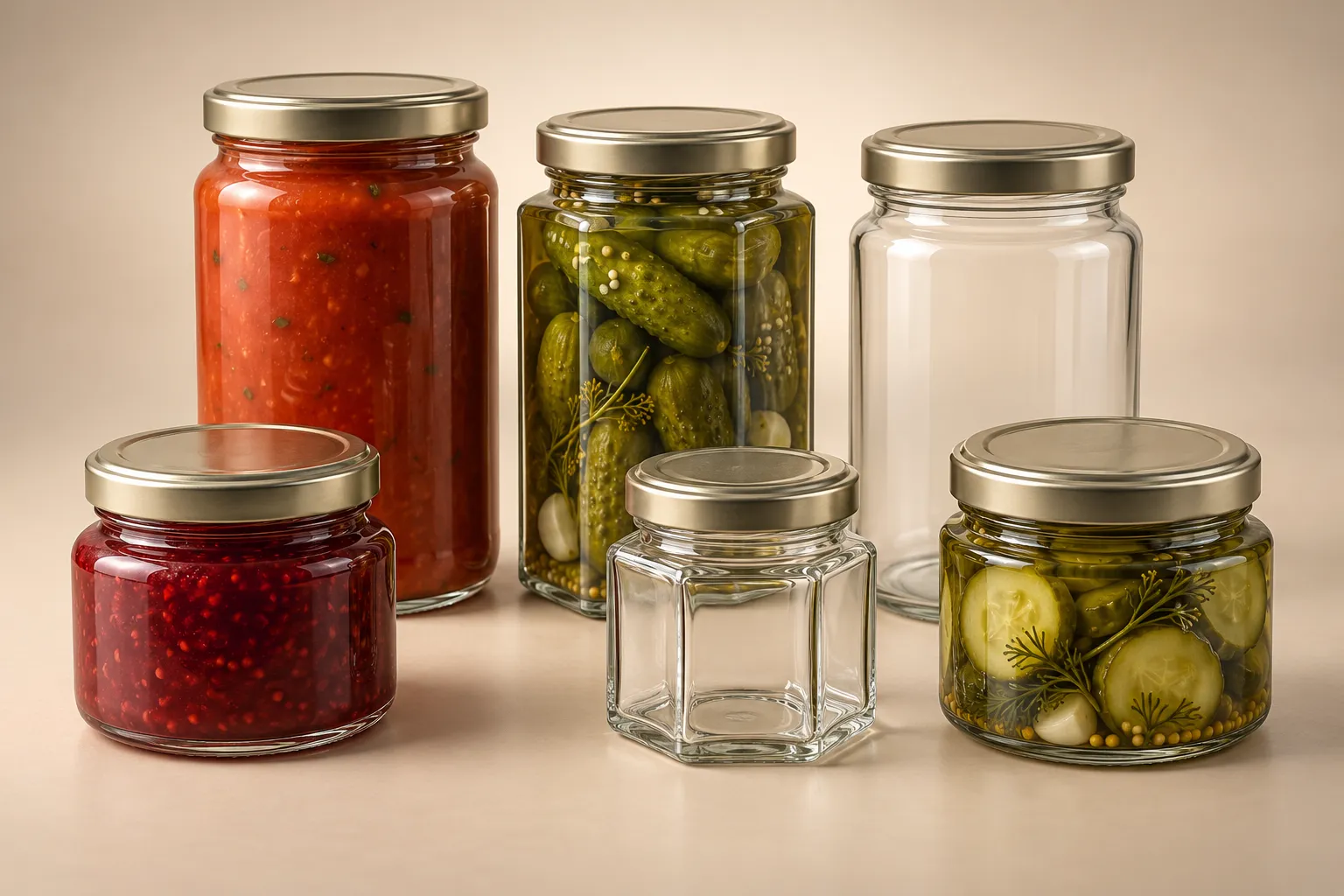
A food jar is three decisions made as one: the body shape, the finish (the threaded or lugged opening) and the closure that seals it. Choosing the body first and the closure last is the most common way to end up with a cap that fits loosely, a seal that does not hold vacuum, or a jar that will not run on the filling line. Start from the process the product goes through (cold fill, hot fill, pasteurization or sterilization) and work back to the closure family, the finish that closure needs, and only then the shape.
This guide covers how those three pieces interact, what the common closure families do, why vacuum matters for processed foods, and what to check before a hot-fill product goes into glass. It is an editorial reading of published sources, not a test report, and it does not replace advice from a process authority or your suppliers.
Anatomy of a food jar
Food jars are described with a small set of terms. The USDA-style closure chapter reproduced by a jar distributor splits the container into the finish, the body and the bottom, and names the shoulder, side wall and heel inside the body. The finish carries the sealing surface and either glass lugs or a continuous thread.
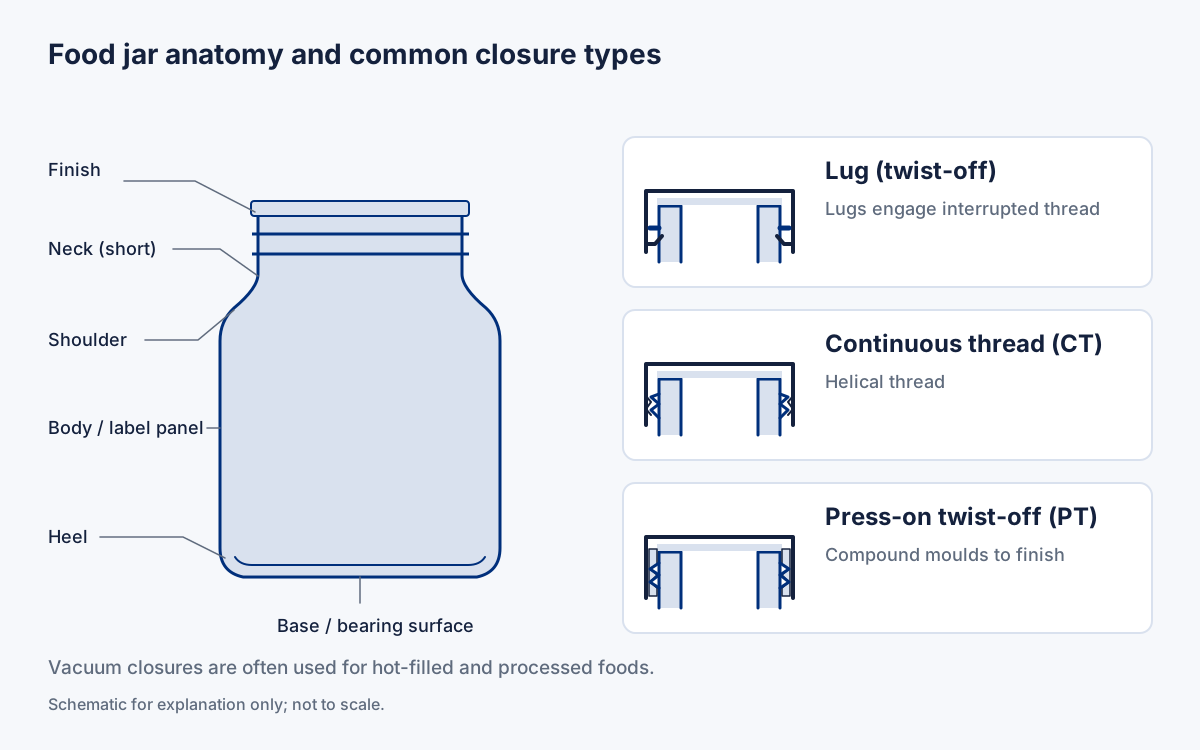
The finish holds the cap and provides the sealing surface. Every closure type is designed for a specific glass finish, and many finishes are standardized by the Glass Packaging Institute, with numbered drawings that give dimensions and tolerances (see the closure chapter in the sources below). The shoulder and side wall set the label panel and how jars sit in a case. The heel and base affect stability on the line and stacking.
Shapes: what to compare
Jar shapes are usually grouped into straight-sided or cylindrical jars, panel jars (flat sides for label space), hexagonal or faceted jars, and tall or tapered jars. Catalogs from glassmakers show how standard families are described. One UK maker, for example, lists panel and standard jars by capacity, weight, diameter and height, and says its technical team works with customers on weight reduction and line compatibility.
Compare shape on more than appearance:
| Shape question | Why it matters |
|---|---|
| Is the body diameter close to the finish diameter? | Wide-mouth jars are easier to fill with particulates and to scoop from, but they place different demands on the closure. |
| Is there a label panel, and is it flat or curved? | Affects labeling method and where a wrap-around label sits. |
| What is the glass weight and distribution? | Heavier jars handle some thermal and handling stresses differently; confirm with the supplier rather than assume. |
| How will it pack and palletize? | Panel and hex shapes change case patterns and layer stability. |
Take capacity and dimensions from the supplier’s drawing, not a photograph. The glass bottle specification checklist is written for bottles, but the same fields (brimful capacity, fill height, weight, tolerances) apply to jars.
Closure families
Three metal closure families dominate glass food jars. The descriptions that follow draw on the USDA-style closure chapter and a closure maker’s technical page.
Lug (twist-off). The cap has inward lugs that slide between interrupted glass threads and lock with a partial turn. A flowed-in plastisol gasket forms the seal. The source says both lugs and vacuum hold the cap in place, and that vacuum is the more important of the two.
Continuous thread (CT). The cap has a threaded skirt that meshes with a continuous spiral ridge on the glass. Metal closure makers also sell deep twist closures styled as continuous thread. One maker describes such a closure as suitable for hot and cold filling and compatible with pasteurization and sterilization, but that is a supplier statement about a specific product, not a general rule for every CT cap.
Press-on twist-off (PT). The cap is pressed onto the finish and is removed by twisting. The closure chapter notes that a lug cap on a PT finish would not work, and that PT caps use a molded plastisol gasket where lug caps use a flowed-in one.
These families are not interchangeable even when the nominal diameter matches. Ask suppliers for the finish designation and the closure specification together. Bottle neck finishes and closure compatibility explains how to read those designations without relying on a single diameter number.
Vacuum sealing for processed foods
Most glass-packed shelf-stable foods use vacuum-type closures. The USDA-style chapter explains that the vacuum inside the package and the resulting outside pressure on the cap help form and maintain the seal. In a steam-flow capper, steam displaces the headspace gases; it is trapped as the cap goes on and then condenses to form vacuum. The same source also names four factors that affect vacuum:
- headspace volume;
- product temperature at sealing;
- air in the product;
- how efficiently the capper produces vacuum.
For low-acid products it gives a rule of thumb of headspace not less than 6 percent of container volume at capping temperature, and says that figure is less critical for acidified products that are hot-filled or pasteurized. That is a guideline for one context, not a specification for your product.
Academic work points the same way. A Cornell professional master’s project using glucose solutions as model foods found that vacuum decreased with lower hot-pack temperatures, lower water activity and greater headspace, and that steam flushing raised vacuum at least 1.5-fold compared with hot packing alone. Model foods are not your product, but the direction of the effects helps when you plan trials.
Many lug and PT caps have a safety button or flip panel. The closure chapter describes it as an aid for detecting low-vacuum packages on the line and as a consumer indicator. It signals a vacuum seal. It does not tell you which thermal process the closure was made for. Plastisols are tailored to product and process, and a closure meant for a pasteurized product may not suit a retorted one.
Hot-fill considerations
Hot-fill-hold is used for acid and acidified foods. A Kansas State University extension fact sheet describes the sequence: heat the product, fill it promptly into pre-cleaned and sanitized containers, apply a heated closure with a steam capper or by hand, then invert and hold so the hot product contacts the headspace and the inside of the lid. It names metal cans, glass jars, or bottles with plastisol-lined metal caps as the container options that give a hermetic seal, and says processing parameters must be verified by a process authority.
Glass adds a handling question that process descriptions often skip: thermal shock. A UK glass supplier’s technical note explains that a large temperature difference between the inside and outside surfaces of a container creates stress, particularly when cold jars are filled with hot product or hot jars meet cold wash water. It recommends storing containers in temperature-controlled areas, gradually pre-warming glass before hot filling, and controlling cooling. It also stresses that resistance varies with container design, weight and geometry, and that suppliers and fillers should communicate about the intended application.
For a hot-fill project, plan these checks with the jar maker, the closure maker and the process authority:
- the filling temperature the jar is intended for, stated by the glass supplier;
- the closure gasket compound and its stated process rating;
- the cooling method and the temperature of the cooling water;
- vacuum measurement at the line, and a response when it drifts;
- storage temperature of empty jars in cold weather.
One note for small producers: home-canning guidance does not endorse industrial lids. Iowa State University Extension says one-piece, reusable and previously used lids are not approved by the USDA for home canning because they were made for industrial settings with tight time and temperature controls. Commercial hot-fill needs a documented process.
Sauces and other products
Viscosity and particulates affect the fill, the fill height and therefore the headspace, which feeds back into vacuum and closure choice. Sauce and dressing bottling lines covers how product type shapes equipment decisions, and capping equipment for bottles and jars covers how the chosen closure is applied on the line.
Questions to send suppliers
- What is the finish designation of the jar, and which published finish drawing does it follow?
- Which closure families and specific closure items do you recommend for this finish, and for which fill and thermal processes are they rated?
- What gasket compound is used, and is it suitable for hot fill, pasteurization, sterilization or oily products?
- Can you provide the jar drawing with brimful capacity, fill point, weight and tolerances?
- What filling temperature range and temperature differential has the jar been designed or tested for, and by what method?
- What recommendations do you have on pre-warming, cooling and storage of empty jars?
- Does the closure have a safety button, and what vacuum level should it indicate on the line?
- Which surface treatments or coatings are on the jar, and could they affect closure performance or labeling?
- Is a sample lot available for line trials, and what food-contact documentation supports the jar and closure in my market?
Evidence and limitations
Closure rules, vacuum targets and hot-fill parameters depend on the product, its acidity, the equipment and the regulatory regime, and the sources below describe general practice or specific products. A process authority should validate any thermal process, and your jar and closure suppliers should confirm compatibility for your actual items. Supplier statements about closure ratings are claims about particular products. The model-food vacuum findings come from one master’s project, not an industry standard.
- Jars Closure (Closures for Glass Containers), ehcan.com: reproduces a USDA-style training chapter covering finish terms, lug, PT and safety buttons, vacuum factors and plastisol gaskets. The text matches a USDA FSIS closure chapter, but the original PDF could not be retrieved for this review.
- Hot-Fill-Hold Process for Acid and Acidified Foods (MF3671), Kansas State University Research and Extension: hot-fill-hold steps, plastisol-lined closures and the role of a process authority.
- Glass Closure Evaluation: Factors Affecting Vacuum in Model Foods, Cornell University (professional master’s project): effects of hot-pack temperature, water activity, headspace and steam flushing on vacuum.
- Thermal Shock in Glass Bottles and Jars, Glassworks International: thermal shock mechanism and handling recommendations from a UK glass packaging supplier.
- Twist closures for glass jars, Tecnocap: manufacturer description of a deep twist closure, plastisol gasket and safety button option.
- Are Two-Piece Lids Really Necessary?, Iowa State University Extension and Outreach: why industrial one-piece lids are not approved for home canning.
- Panel & Standard Jars, Verallia UK: example of how a glassmaker catalogs jar families by capacity, weight, diameter and height.
Related guides

Bottle Neck Finishes and Closure Compatibility
How to read finish designations such as 28-400 and the T, E, I, H and S dimensions, and why a matching nominal diameter does not prove a closure fits.
Read the guide
Choosing Capping Equipment for Glass Bottles and Jars
Prepare a capping requirement from finish and closure data: screw, ROPP, crown, lug, press-on and cork application, torque, and how to verify closures.
Read the guide
Sauce and Dressing Bottling Lines: Matching Product, Container and Equipment
Write product properties, container choice and equipment needs as one specification for sauce lines, from viscosity and acidity to hot-fill and vacuum.
Read the guide