
Case Packing and Palletizing for Glass Bottles: Layout and Protection
How to compare case styles, drop and pick-and-place packers, partitions, tier sheets and pallet containment for glass, and which logistics rules to confirm.

The back end of a glass bottling line has three protection jobs: keep filled bottles from touching each other, keep labels and closures intact inside the case, and keep the pallet stable from your dock to the receiving dock. Choose case packing and palletizing equipment around those jobs, not around a speed figure alone. The choices that matter are the case style, how bottles enter the case, what separates them inside it, and how the finished pallet is built and contained.
A requirement document should therefore start with the bottle and the shipping route. Give suppliers the case drawing and board grade, the partition design, the pallet pattern you want, and the retailer or carrier rules you have to meet. Equipment makers can then quote a machine that handles your actual case rather than a generic one. This guide covers each decision in that order and ends with questions to send suppliers.
Start from the packed case, not the machine
Work backward from what leaves the building. A filled, labeled glass bottle is heavy and sensitive to point impacts and scuffing. The pack design is the main protection, and the machine only has to build that pack repeatably.
Before comparing machines, collect the inputs that every supplier will ask for: bottle height, diameter and weight when filled; closure type and height; label type and position; the case or tray drawing; and the pack count and pattern.
Case styles for glass
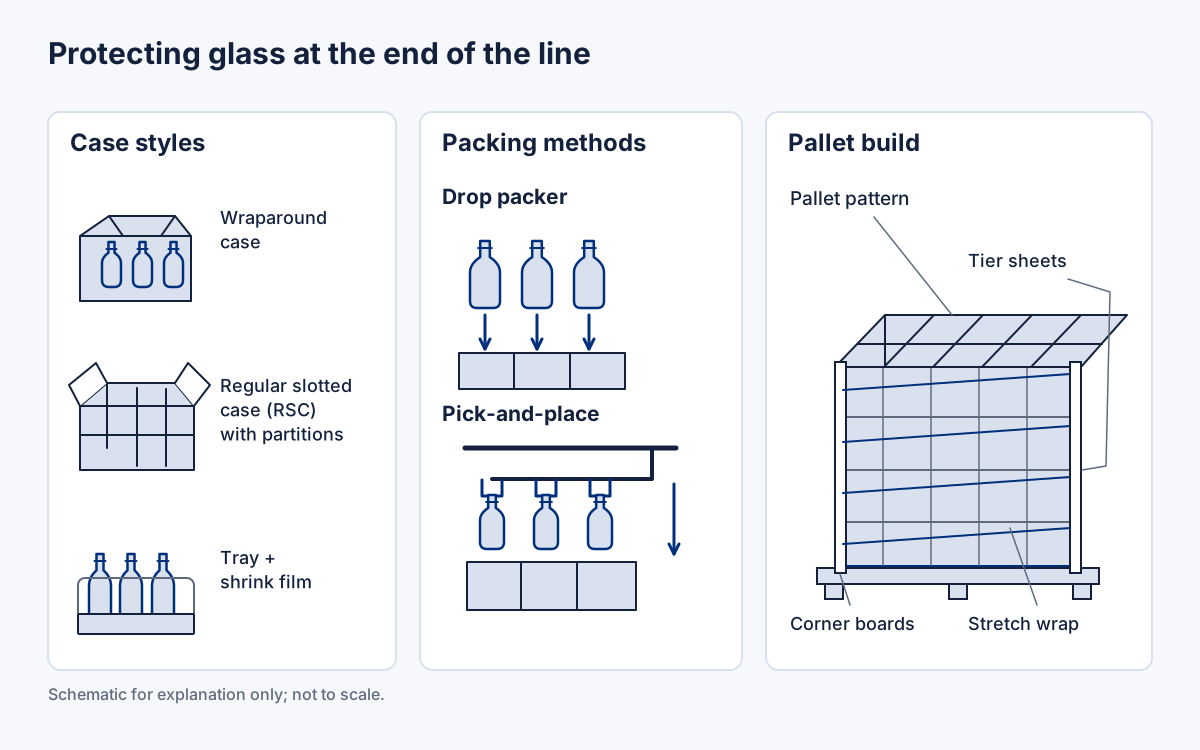
Equipment-maker explainers describe a small set of case styles, and each treats glass differently.
| Style | How it is made | What to consider for glass |
|---|---|---|
| Regular slotted container (RSC) with partitions | Pre-glued knock-down case is erected, then loaded from the top; cell partitions separate bottles | Familiar and easy to source; partitions give bottle-to-bottle separation; needs a partition inserter or pre-assembled partitions in the process |
| Wraparound case | Flat blank is folded and glued around the grouped bottles | Case is formed to fit the pack; makers cite corrugated savings; grouped bottles may touch unless a divider is built in |
| Tray plus shrink film | Open corrugated tray (or pad) holds the bottles, film is shrunk over them | Lower corrugated use and shelf-ready look; offers less enclosure and fewer places to protect labels, so check shipping tests |
According to Blueprint Automation’s explainer, the RSC is the typical knock-down case for shipping through distribution, while a wraparound blank is fastened by a machine and can be cut to fit the contents closely. The same source describes tray cases as an RSC variant lacking one side panel, often overwrapped for retail. Treat corrugated-savings claims as supplier statements.
For heavy glass, confirm whether the design includes protection between bottles, whatever the style is called. Smurfit Westrock describes box partitions as dividers made from paperboard or corrugated board that protect several products in one outer case by adding cushioning, restricting movement and improving stability. Wraparound and tray packs need internal dividers or pads to reach similar separation, and that must be in the case drawing.
Drop packing vs. pick-and-place
How bottles get into the case is the main mechanical difference between machine types.
- Drop packers gather bottles over an open case. According to Hamrick Packaging Systems’ comparison, the pattern falls through a packing grid while the case is raised and then lowered. The company lists high speed and the lowest capital cost among the benefits, and notes that vertical loading may not suit fragile products.
- Gantry pick-and-place packers use servo motion to lift products and set them into the case. Hamrick describes this as gentler handling with recipe-based changeovers, at the cost of a larger footprint, more servo axes and possible tooling changes between products.
- Robotic packers use articulated robots. The same explainer rates them as the most flexible for mixed cases and frequent SKU changes, and as a higher-cost option with more complex controls and safety systems.
These are equipment-maker positions, not test results. For glass, ask how the grid or gripper tooling handles your bottle weight and label, and what happens to a bottle slightly out of tolerance.
Protecting glass inside the case
Protection inside the case is a design deliverable. Agree it before you select a machine.
- Partitions and pads. Confirm cell size relative to bottle diameter, partition board, and whether the partition is inserted before or after the case is erected. A partition that is too tight can scuff labels; one that is too loose lets bottles move.
- Labels. Ask how long labels need to cure or dry before bottles touch partitions, and see bottle labeling methods for what each label system implies at the end of the line.
- Closure protection. Silgan Closures’ technical bulletin recommends corrugated dividers between pallets of tray-packed product to protect closure tops and spread load, and advises that finished product not be shipped frozen because glass can fracture.
- Case strength. Board grade, flute and compression strength are specified by the case supplier, not the machine maker.
Building the pallet
Pallet pattern
Pallet pattern trades vertical strength against side-to-side stability. One pallet-building explainer describes column stacking as maximizing compression strength by aligning vertical edges, but offering less resistance to side shifts, and interlock or brick patterns as giving more lateral stability at some loss of vertical capacity. For glass, the pattern also decides how much weight bears on the bottles through the case and whether tier sheets are needed. Silgan’s guidance for finished pallets adds that overhang should be minimized and cartons should rest on the pallet deck. A palletizing supplier should show the pattern on a layer drawing for your case and pallet size.
Tier sheets
Tier sheets (layer pads) are placed between layers. Handle-It’s bottle-pallet tips suggest tier sheets between layers for stack stability. Cartonplast describes plastic layer pads for glass containers that have rounded corners suited to shrink film and sheet handling by automated equipment. Both are supplier statements. Tier sheets also matter at the other end of the line, covered in depalletizers and infeed systems. Decide whether sheets are single-use or returned, and who places them.
Corner boards and containment
Corner boards or edge protectors disperse strapping or film force along a rigid edge. Millwood describes them as distributing strapping tension and improving unitization. The pallet-building explainer also says corner boards let film be applied at higher tension without crushing cartons, and notes that three to five tight wraps around the base is a commonly advised starting point for catching the pallet deck. Handle-It cautions against over-tensioning stretch film because it can crack glass, and recommends vertical strapping for tall, narrow bottle pallets. Silgan recommends machine stretch wrapping for consistent tension and advises against excessive tension that buckles cartons. Specify wrap tension, number of wraps, film type and whether a top sheet or strapping is needed, and agree how the wrap pattern is validated.
Logistics and retailer requirements to confirm
Retailers and carriers publish their own rules, so confirm them before you lock layout and pallet pattern. Check at least the following.
- Pallet footprint, grade and ownership, such as pooled or one-way.
- Maximum pallet height and weight, including the pallet itself.
- Overhang limits and whether the pallet must be double-stackable.
- Label rules: GS1-128 shipping-container labels, SSCC numbers, label positions and print quality. A labeling vendor’s explainer notes that an SSCC is an 18-digit code in a GS1-128 barcode and that it must agree with the advance ship notice.
- Distribution test expectations. ISTA’s Procedure 3E is a general simulation test for unitized loads of retail packaged products shipped by truckload to a distribution center, so ask the customer whether a test like this is required.
Verify each one, because values differ by customer and program and change over time.
Questions to send suppliers
- Which case styles can the machine handle for our bottle, and which tooling is needed for each? Please quote any partition inserter, case erector, sealer and pad or sheet placers as separate lines.
- How are bottles placed into the case, and which parts of the bottle touch the grid, gripper or partition?
- What bottle and label tolerances does the design assume?
- How are bottles accumulated and grouped before the packer, and how does this interface with the upstream equipment described in planning a glass bottling line?
- Which pallet patterns are supported, how are tier sheets, top sheets or frames placed, and who supplies them?
- What stretch wrap, strapping and corner-board options are included, and what tension and wrap pattern are validated?
- What case, label and pallet information does the controller print or verify?
- Which format changes need change parts and which are recipe-only?
- What documentation, spare parts and training are included, and what will be tested at factory and site acceptance? The bottling equipment RFQ checklist lists the points to compare across proposals.
Evidence and limitations
This guide is editorial analysis of publicly available explainers, not hands-on testing. Case style, packer type, partition design and pallet pattern all depend on bottle weight and shape, label, line speed, case supplier and customer requirements. Equipment-maker pages describe general capabilities and carry commercial interests, so confirm their statements for your specific configuration. Figures such as pallet limits, wrap counts and retailer rules differ by program and are not given here.
- Four Types of Case and Tray Packers, Blueprint Automation: defines RSC, tray, wraparound and harness cases and loading configurations.
- Types of Case Packers: Drop, Pick-and-Place, and Robotic Compared, Hamrick Packaging Systems: compares drop, gantry pick-and-place and robotic packers, including trade-offs.
- Box partitions, Smurfit Westrock: describes partitions as protective dividers for multiple products in one case.
- End-of-Line Packaging for Bottles, Handle-It: pro tips on tier sheets, pre-stretch, strapping and avoiding over-tensioned film on glass.
- Plastic layer pads, Cartonplast: supplier description of layer pads for glass containers and automated handling.
- Edge Defender edge protectors, Millwood: explains edge protectors in strapped and wrapped unit loads.
- Pallet Building 101, Cleverence: vendor explainer on column versus interlock patterns, wrapping and corner boards.
- Steel Closure Operating Guidelines (TAB4), Silgan Closures: tray packing, palletization and shipping guidance for glass with steel closures.
- ISTA 3E overview, International Safe Transit Association: scope of the unitized-load truckload simulation test.
- SSCC Pallet Labels Explained, Certified Labeling Solutions: describes SSCC and GS1-128 pallet labels and their link to advance ship notices.
Related guides
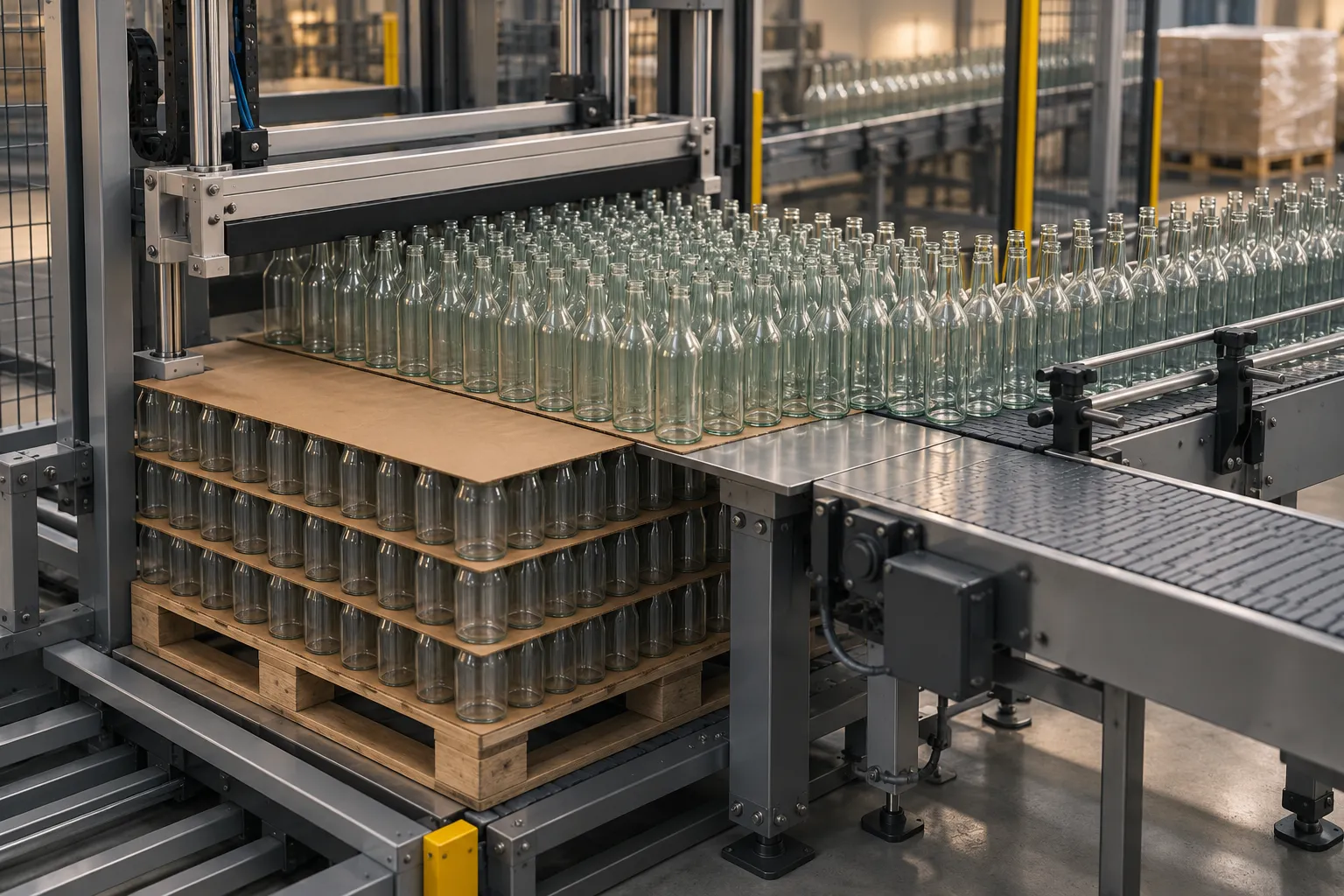
Bottle Depalletizers and Infeed Systems: A Selection Guide
How empty glass arrives (bulk pallets with tier sheets or cased), how layer sweep-off compares with other methods, and what to specify for single-filing.
Read the guide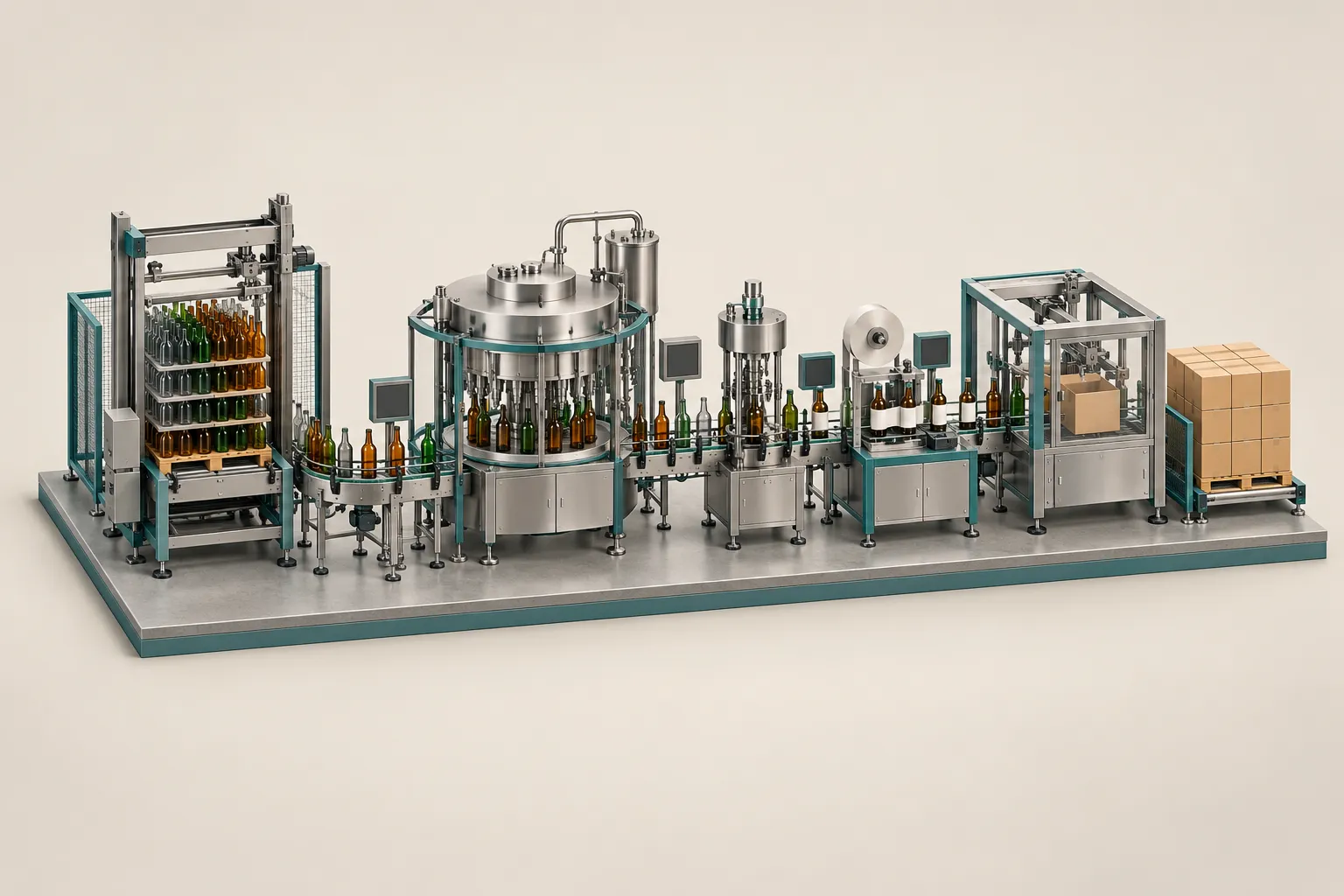
Planning a Glass Bottling Line: From Empty Bottles to Packed Cases
How to divide a glass bottling line into stations, size buffers around the bottleneck machine, and confirm machine interfaces before requesting quotes.
Read the guide
Bottling Equipment RFQ Checklist: Comparing Supplier Proposals
How to write a bottling equipment RFQ so suppliers quote the same inputs, scope and performance basis, with a matrix for FAT, SAT, spares and warranty.
Read the guide