
Beer Bottling Equipment: Questions for Line Suppliers
Questions for bottling-line suppliers on oxygen pickup, counter-pressure filling, foaming, crowning, pasteurization, and fill-level and crown inspection.
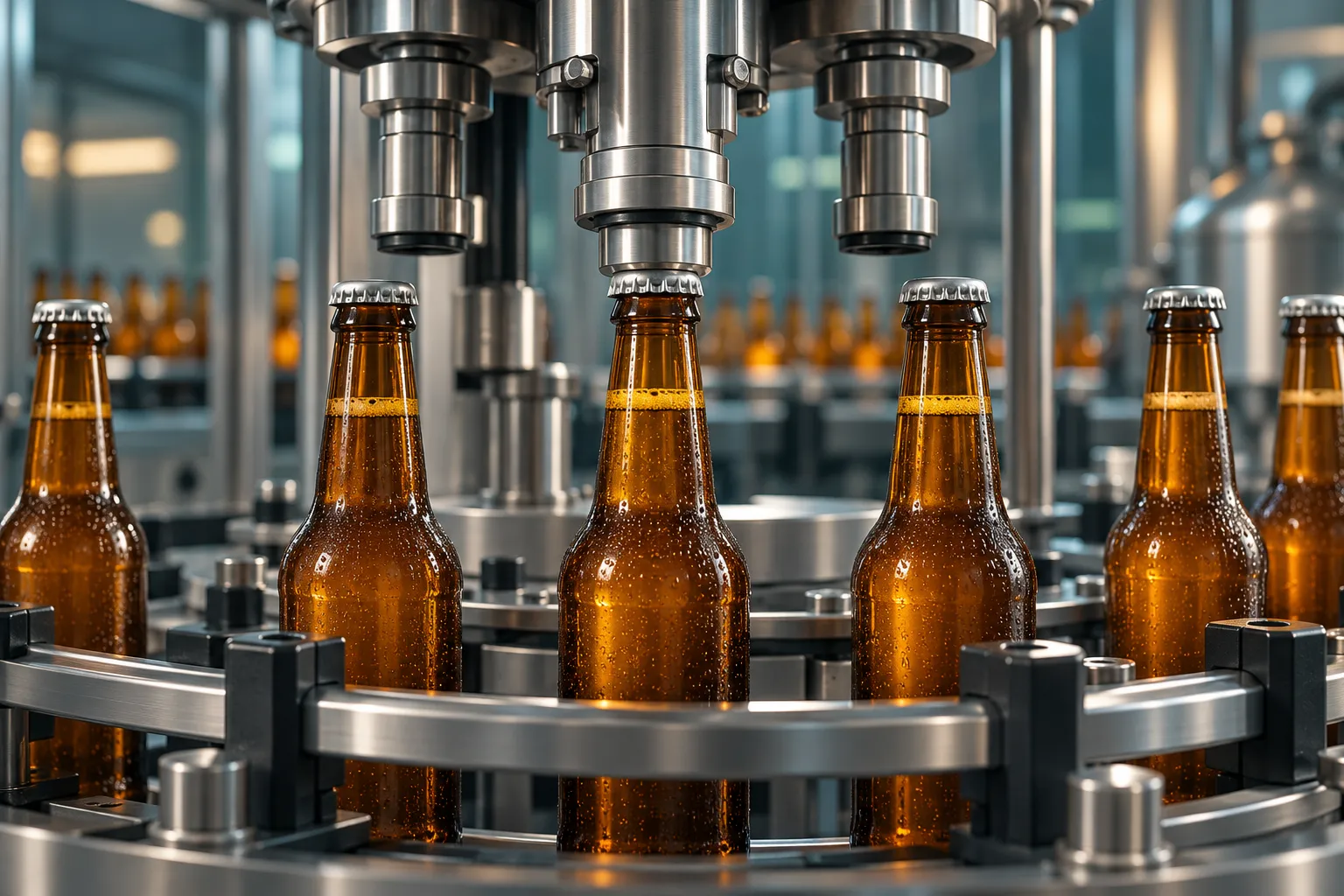
Bottled beer is oxygen-sensitive, carbonated and foamy, so a beer bottling line is judged less by how fast it fills than by how little air the finished package contains and how reliably it closes. Ask suppliers how the line removes air before filling, how it fills against counter-pressure, how it controls foam at the moment of crowning, and how you will measure the result. The answers differ by filler design, bottle and product, so ask for them in writing and tie them to a test.
A second group of questions covers the decisions around the filler: which crown and finish, whether the beer will be pasteurized or stabilized another way, and what inspection checks fill level and closure. This guide covers those product and process questions in the order a brewery would raise them, and ends with a numbered list to send suppliers. For the general comparison of filling principles, see glass bottle filling machines.
Define the product and package first
A supplier cannot judge oxygen control or stabilization without knowing what is going into the bottle. Prepare these inputs before asking for a quote.
- Beer styles and carbonation range, including any hop-forward or heavily dry-hopped beers and whether any bottle-conditioned product is planned.
- Bottle shapes, finish and glass strength. The crown finish and bottle pressure rating matter for crowning and pasteurization, so use the bottle specification checklist and read bottle neck finishes and closure compatibility.
- Target output and the number of formats, including future bottle changes (bottling-line changeovers lists what to check when a new bottle arrives).
- Incoming beer quality: dissolved oxygen, temperature, carbonation and clarity at the filler.
- Shelf-life target and storage conditions.
Where oxygen enters a bottle
Brewing literature separates dissolved oxygen (DO) in the beer from headspace oxygen, and combines them as total package oxygen (TPO). In the Craft Brewers Conference case study from Pelican Brewing, DO is the oxygen dissolved in the beer in parts per billion, and TPO is a calculated value that accounts for DO and standardizes it across package sizes using temperature, liquid volume and headspace volume. A workshop from the American Society of Brewing Chemists adds that bottles are harder to evacuate and generally pick up more dissolved oxygen than cans, which pick up more headspace oxygen.
Oxygen also comes from the closure and the line. The same workshop lists crowns and closures, vacuum evacuation (including minimizing residual rinse water), jetting, the crowner and filler speed as bottle-filling factors. The Pelican case study found that worn seals, button valves and similar parts were frequent sources of DO pickup on an older line, and that maintenance of internal seals mattered. That is one brewery’s experience, but it supports asking suppliers about wear parts and service intervals.
How oxygen is measured matters more than a claimed number. The Pelican study reports that packaged-air tests and DO/TPO results showed very little correlation on its rebuilt line, with DO/TPO a more sensitive test. It also used its own targets, aiming for a TPO of 100 ppb or lower and treating 500 ppb as a minimum standard; those are one brewery’s targets, not an industry specification. Ask suppliers which method will prove oxygen performance, who performs it and under which conditions.
How the filling sequence controls oxygen
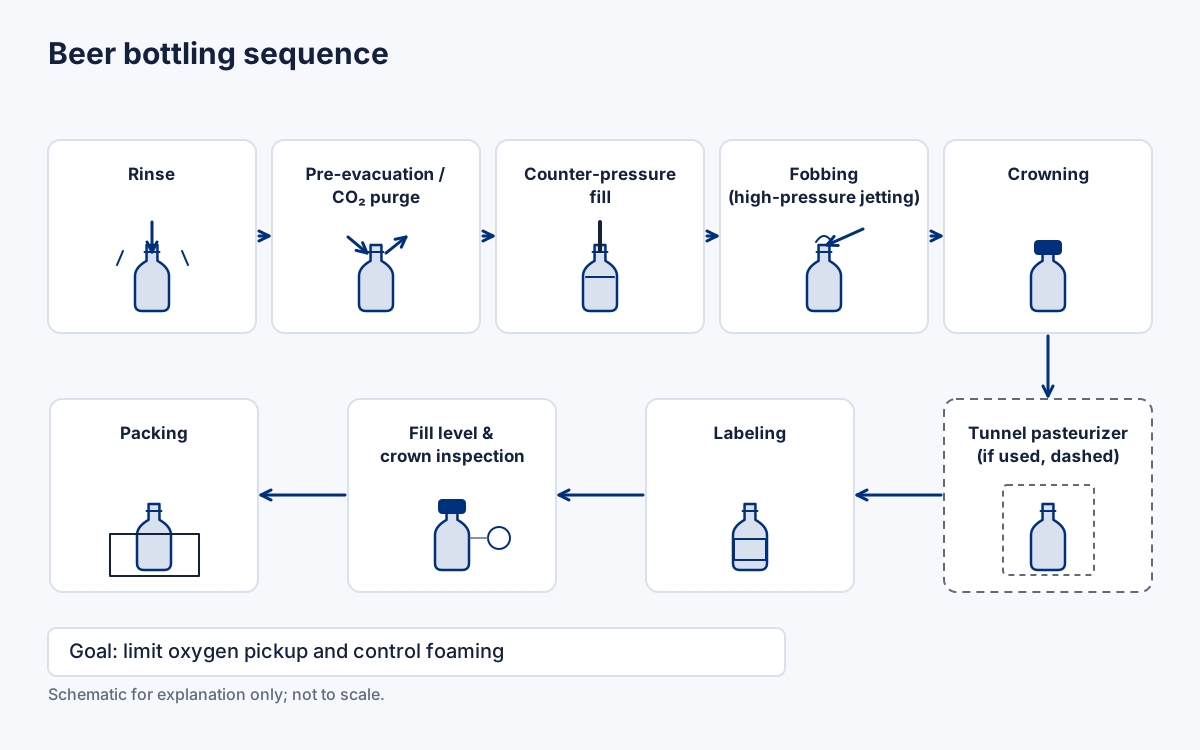
Most bottle fillers combine several steps. The table shows what each is for and what to ask.
| Step | Purpose | What to ask |
|---|---|---|
| Pre-evacuation | Removes air from the bottle before filling, often with one or two vacuum cycles | How many cycles; how is vacuum timing set; how is residual rinse water handled? |
| CO2 purge or pre-sparge | Replaces remaining air with carbon dioxide | Is CO2 purge part of the design or an option; what is the gas consumption basis? |
| Counter-pressure fill | Fills against gas pressure so carbonation stays in the beer | Is it a fully counter-pressure design; how are valve seals, lift cylinders and tower seals maintained? |
| Fobbing or jetting | Foams the beer just before crowning so foam displaces headspace air | Which method is used (such as a high-pressure water jet); how is water quality managed; what is the foam spillage? |
| Crowning | Seals the bottle | How is crown height and pressure controlled for your finish and crown? |
The Pelican study notes that even after two vacuums slight residual atmosphere remains, and CO2 pre-sparging helps reduce oxygen accumulation in the filler bowl headspace. It also describes continuously flushing the bowl headspace with CO2: without it, raw DO rose by about 100 ppb over a five-hour packaging run on that machine. Treat the number as that brewery’s observation, not a general rule, but ask whether the filler design addresses bowl headspace oxygen over a long run. The ASBC workshop lists jetting among the bottle-filling factors to manage. The purpose column in the table is an editorial summary of common practice, so ask each supplier to describe its own implementation.
Because bottles are harder to evacuate, look at pre-evacuation and fill-valve design before comparing rated speeds.
Crowns and closure choices
The crown is part of the oxygen system. Crown Holdings describes oxygen-scavenger and oxygen-barrier crowns, easy-open crowns, and a range of twist-off and pry-off crowns with different metal weights and liner profiles, selected for removal torque and pressure retention. The ASBC workshop notes that crown liner materials can scalp beer flavors or contribute off-flavors, and that the oils and waxes used to reduce twist-off torque can contribute contaminants.
Ask the supplier which crowns and crown finishes the crowner has been set up for, how crowning pressure and height are controlled, and how crowns are fed and protected. If your project includes jars or other closures on the same line, the capping equipment guide compares closure application methods. Confirm that the crown and crowner suppliers agree on the crown specification.
Pasteurization vs. other stabilization
Stabilization is a product decision before it is an equipment decision. A Craft Kettle explainer notes that beer is an environment unwelcoming to pathogens and that pasteurizing beer is primarily for quality and shelf-stability reasons. It describes flash pasteurization as a high-temperature, short-time treatment before packaging, tunnel pasteurization as treatment of sealed bottles or cans, and says kegs are too large to tunnel pasteurize. It defines a pasteurization unit (PU) as one minute at 60 C (140 F), so 15 minutes at 60 C is 15 PUs, and says required PUs vary by brand and brewery.
These questions follow.
- Is stabilization needed for your distribution distance and shelf-life target, or will sterile filtration and clean filling be enough?
- If a tunnel pasteurizer is included, how are bottle thermal conditions managed, who sets the PU target, and how is it verified in the package?
- If flash pasteurization or filtration is used, what keeps the filler and bottle clean afterward, since the heat treatment does not cover contamination picked up downstream?
- How do pressure, headspace and crown choice interact with the heat treatment?
Fill-level and crown inspection
Heuft describes the checks performed in the outfeed area of the filler block as fill level, closure presence and, if necessary, closure position, residual air (especially for beer) and tightness. It lists photocell, X-ray or gamma absorption, and high-frequency measurement for fill level, notes that X-ray or gamma methods require a special licence and trained staff, and says modern devices can report how often a given filler valve produces an underfilled container. That statistics feature can inform maintenance, so ask for it.
Foam is the complication for beer. Ask how inspection sensitivity is set when foam is present just after the crowner, what faults are rejected (low fill, missing crown, high or cocked crown, residual air), and how rejected bottles are removed. The scope of what each system checks and where it can miss defects is covered in bottle inspection systems. Also decide whether a second closure inspection should be placed later in the line, for example after labeling or pasteurization.
After the crowner
Bottles then move to labeling and packing. Wet bottles from a tunnel or condensation affect labeling, so check the conditions the labeler is rated for. For cases and pallets, see case packing and palletizing for glass bottles. To see how the filler, crowner, pasteurizer and inspection fit with the rest of the plant, use planning a glass bottling line.
Questions to send suppliers
- What is the filler design (counter-pressure, number of pre-evacuation cycles, CO2 purge) and which of these are standard versus optional for our beer and bottle?
- What oxygen performance do you claim, in what units (DO, TPO), at what incoming beer DO, and on which measurement method? Will you demonstrate it at factory and site acceptance?
- How does the filler manage bowl headspace oxygen and CO2 consumption over a full run?
- Which fobbing or jetting method is used, and what are the requirements for water, gas and utilities?
- Which crowns and bottle finishes are supported, and how are crown height and sealing pressure verified?
- Which wear parts (valve seals, lift cylinders, tower seals) need regular replacement, and what spare parts and service training do you provide?
- Do you offer a pasteurizer or partner equipment, and what does your proposal include (heating, cooling, water treatment, PU monitoring)?
- What inspection is included for fill level, missing and misapplied crowns and residual air, and how is it adjusted for foam?
- Which formats can run without change parts?
- How are the interfaces with labeling, packing and the rest of the line defined in your scope? The bottling equipment RFQ checklist shows how to make proposals comparable.
Evidence and limitations
This is editorial analysis of public technical material, not a hands-on evaluation of any machine. Oxygen performance, foaming and stabilization depend on the beer, bottle, filler configuration, maintenance and measurement method, and the brewery case studies describe specific lines. Numeric targets in the literature are one brewery’s practice, not standards, and equipment suppliers’ claims should be treated as claims until demonstrated.
- Teaching an Old Bottling Line How Not to Suck (Air), Craft Brewers Conference (Brewers Association), Pelican Brewing presentation: DO versus TPO, targets, pre-evacuation, CO2 purge and valve seal maintenance on one bottling line.
- The Science Behind Packaging Quality, American Society of Brewing Chemists workshop slides: crown liner effects, bottle versus can oxygen characteristics and TPO troubleshooting.
- Caps and Other Offerings, Crown Holdings: describes oxygen-scavenger crowns and twist-off and pry-off crown variants.
- Pasteurization, Craft Kettle: explains flash versus tunnel pasteurization and the pasteurization unit.
- Inspection systems in the filling plant, Heuft: equipment-maker description of fill level, closure and residual-air checks after the filler.
Related guides
Glass Bottle Filling Machines: How to Compare Filling Principles
Compare gravity, vacuum, counter-pressure, piston and flowmeter filling for glass bottles by product, container and line fit, and learn what to ask suppliers.
Read the guide
Bottle Inspection Systems: Comparing What Each System Checks
Compare empty bottle, fill level, closure, label and code inspection by scope and limits, and ask for reject verification, test bottles and validation records.
Read the guide
Bottling Equipment RFQ Checklist: Comparing Supplier Proposals
How to write a bottling equipment RFQ so suppliers quote the same inputs, scope and performance basis, with a matrix for FAT, SAT, spares and warranty.
Read the guide